Mold Odor Removal in Biloxi, MS
The hall closet smells like a wet cardboard box no matter how many times you empty it. Or the guest room smells fine until it rains and then it doesn’t. Or the first blast from the vents every morning smells like a boat cabin. You can’t see anything, and you’ve run out of candles. That musty smell has a source. Call and tell us where you smell it. We handle mold odor in Biloxi, D’Iberville, and the eastern Mississippi Gulf Coast.
A smell is a location
Mold gives off that odor as it grows, so a musty room is a room with growth in it or air moving through it from somewhere that does. CDC says a musty smell is reason enough to act, with or without anything visible. The usual places: the back of a closet on an exterior wall, the cavity under a window that leaks in a north wind, the ceiling under a slow roof drip, the cabinet floor under a sink, a duct run sweating through the attic, or the subfloor over a damp crawl space. Sprays, plug-ins, and candles change what you notice for an afternoon. They don’t change the material.

What to tell us about the smell
- Which room it is strongest in, and whether it gets worse after rain or when the AC starts.
- A house that sat closed for weeks after a storm often smells different when the door opens — say so if that’s what happened.
- Knowing when the water event happened makes the next conversation much easier, even if it was a year ago.
- Condo or house, the fix starts with a phone call, not a plug-in.
Tell Us Where You Smell It, 24/7
What the work looks like
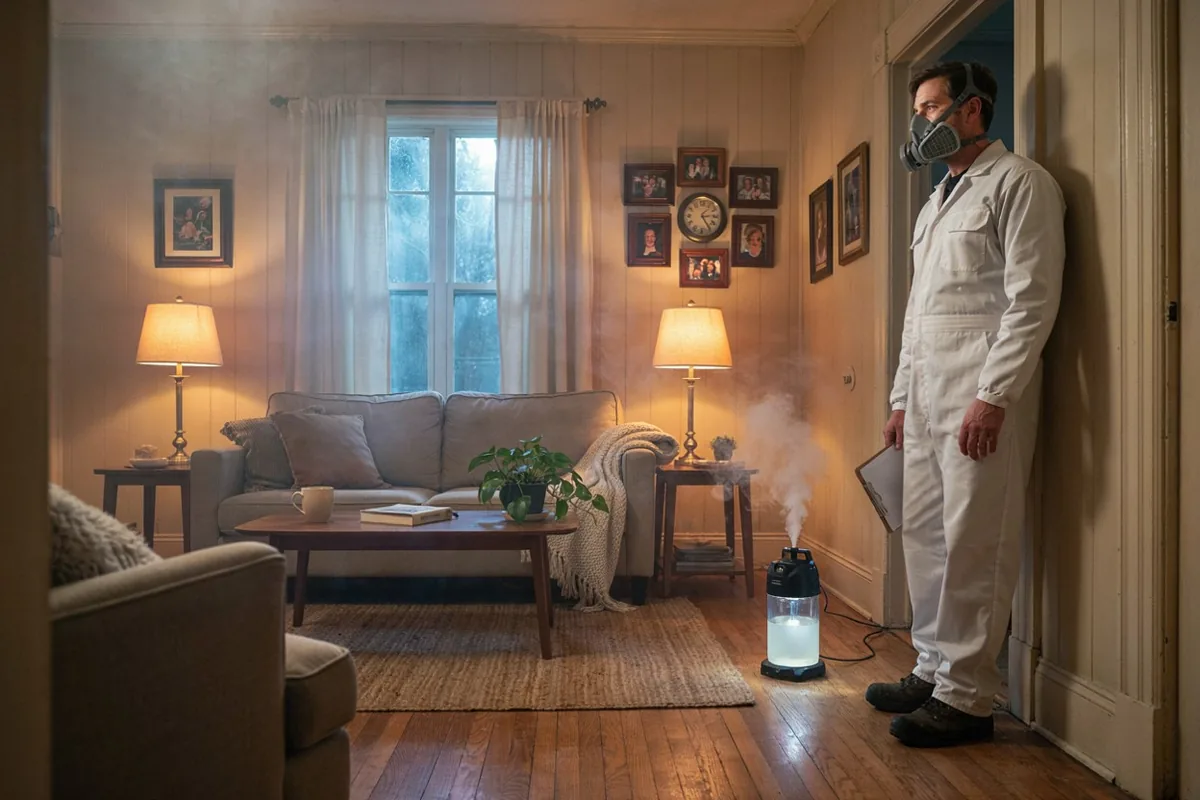
We follow the smell to the material — the wall cavity, the ceiling, the cabinet, the duct — and open it. Whatever is wet and growing comes out inside a sealed, negative-pressure work area and gets bagged before it moves. The framing behind it gets cleaned and HEPA-vacuumed and dries before anything closes up. We tell you what has to change so the water stops. When the material is gone, the smell is gone with it; nothing gets masked, and nothing gets closed back up wet.
Biloxi notes
On this coast the smell often shows up in a house that was shut for the summer, a condo on Beach Boulevard opened after Labor Day, or a house rebuilt after 2005 where one room never dried right before the drywall went on. Biloxi’s morning humidity stays high in every season, so a leak that would dry out somewhere else keeps feeding the smell here. If one room smells different from the rest of the house, that is the call.